Meria obtains the MiCA license


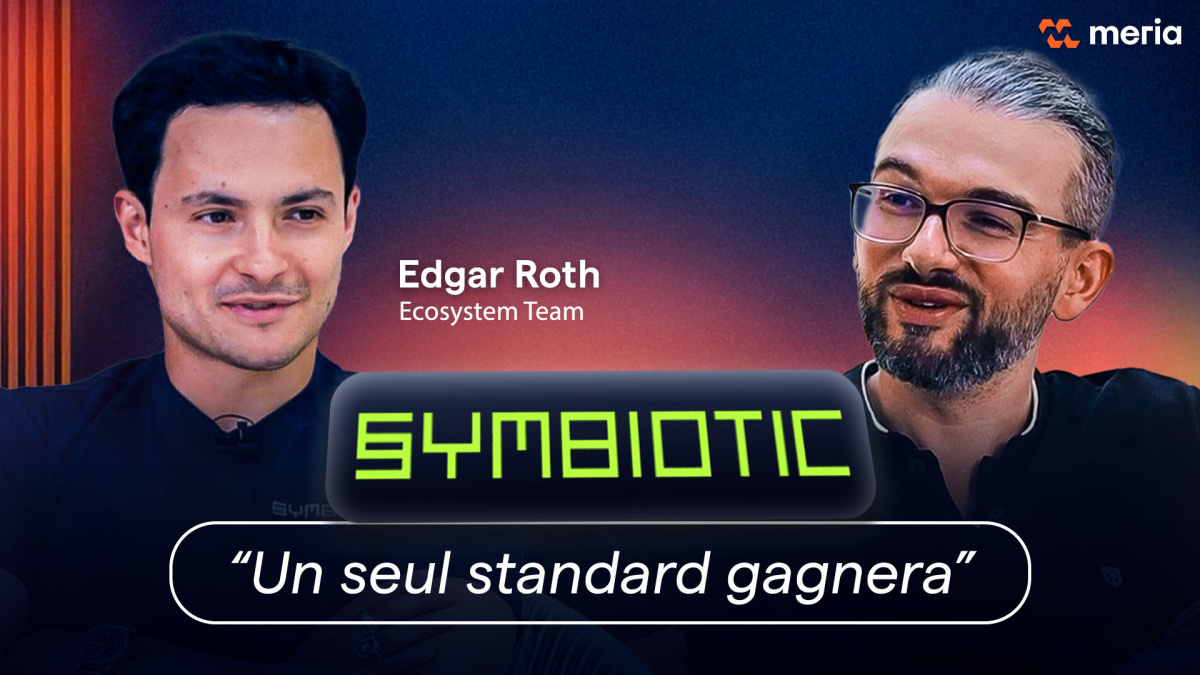
Symbiotic: Only One Restaking Standard Will Win | Interview with Edgar Roth
In this article, we revisit Episode 6 of the On Chain On Air podcast. Edgar Roth, Protocol Specialist at Symbiotic, shares his journey in the blockchain space—from Paris Blockchain Week to Ledger, passing through Kiln—before joining Symbiotic a few months ago. In this episode, we discover why Edgar decided to join Symbiotic, how the project works, and how Symbiotic positions itself regarding competing protocols. Let’s dive in.
Table of contents:
1. What is Symbiotic?
2. How does Symbiotic work?
3. What role does Meria play within Symbiotic?
4. What’s next for Symbiotic?
What is Symbiotic?
“Think of Symbiotic as the staking module for crypto. Plain and simple.”
Symbiotic is a shared security protocol—essentially a marketplace for economic security. In practical terms, Symbiotic enables protocols to benefit from security provided by users who have crypto assets available for staking. This system allows stakers to maximize their returns, while many networks benefit from reliable and robust security.
How does Symbiotic compare to competing protocols?
“Eigen Layer, SSV, Symbiotic are staking standards for protocols [...] At some point, one standard will win and capture the vast majority of the market.”
After such a statement, Edgar explains that Symbiotic aims to be as flexible as possible to support a wide range of use cases. As an example, according to Edgar, onchain insurance protocols —which we'll discuss later in the article— cannot be secured via Eigen Layer due to the incompatibility with its restaking model.
How does Symbiotic work?
Here are the main components that make up Symbiotic's infrastructure:
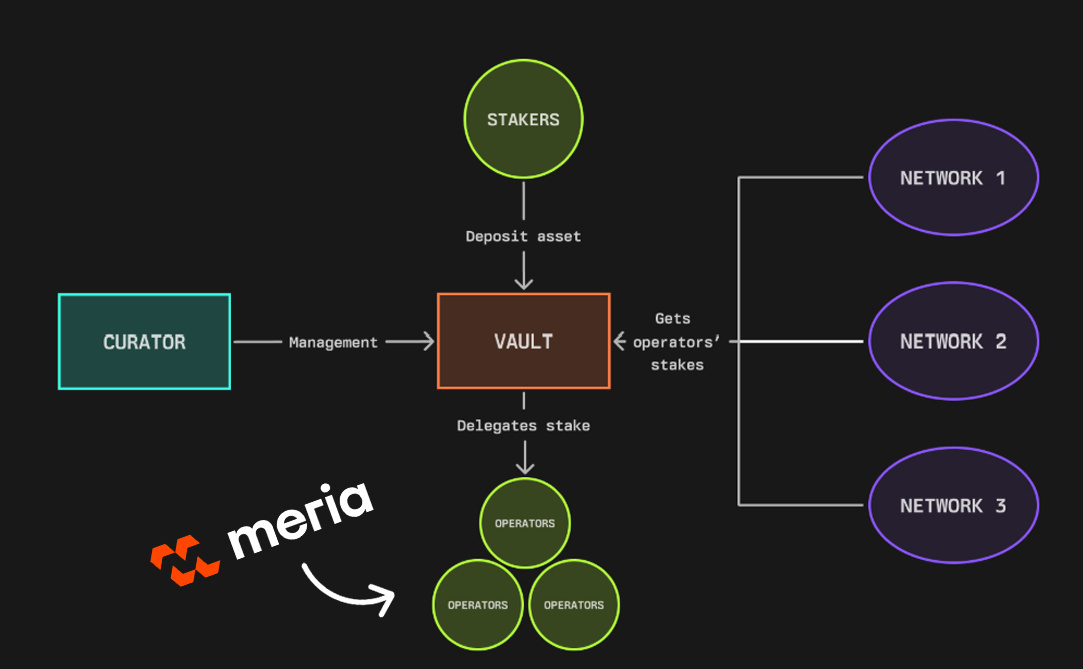
The Vault, a customizable smart contract where stakers deposit their assets.
The stakers, investors (individuals, institutions, LRTs) seeking to maximize their income by supplying assets to the platform via deposits into a vault.
The networks, protocols in need of security that leverage Symbiotic’s services. These can include Layer 1, Layer 2, or any other protocol requiring additional security through staking.
The curators, who can be thought of as “managers/owners of the vault.” These curators define the vault’s parameters and strategies, and manage the liquidity within them.
The resolvers, who determine when a specific action should be triggered. For instance, resolvers activate slashing when a validator fails to meet required conditions. They enforce rule compliance.
The operators run nodes and validators to secure the networks using Symbiotic’s vaults. Depending on configuration, a vault may be operated by one or several operators, securing one or multiple networks.
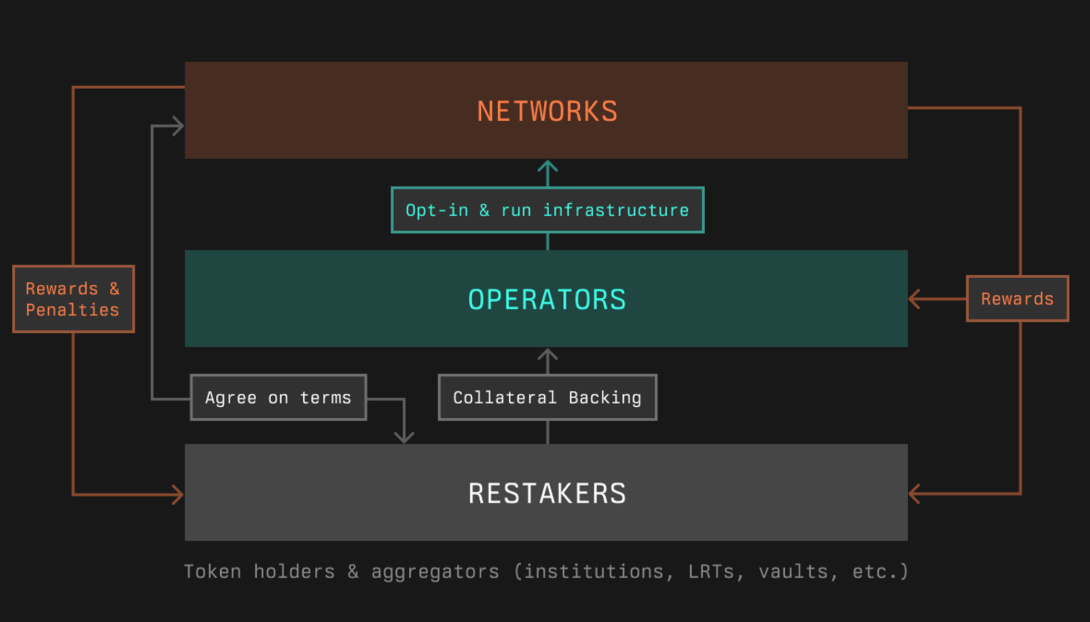
Here’s the path followed by a user who wants to delegate funds into a Symbiotic vault:
After staking assets through a liquid staking or liquid restaking protocol, the user —called a staker— receives Liquid Staking Tokens (LSTs) or Liquid Restaking Tokens (LRTs) to deposit into vaults on Symbiotic. This generates additional yield.
Each vault has its own parameters and secures different networks. In case of failure or misconduct, the vault’s resolver will initiate slashing of the operators, resulting in a loss of a portion of the funds. This means the placement carries risks.
Delegated and locked assets can be used to secure multiple networks across various blockchains in the Ethereum Virtual Machine (EVM) ecosystem without leaving the Ethereum blockchain. This is made possible by Symbiotic Relay.
Symbiotic Relay
“It’s a foundation that will eventually enable multichain staking. It will allow different Symbiotic contracts on different virtual machines (VMs) to communicate with each other. Staking on Symbiotic will then be possible across many different VMs.”
The Symbiotic Relay links all previously mentioned entities and ensures multichain compatibility.
When a protocol sends a task to be executed, the operators respond to the request. The Relay collects a proof of execution and sends it to the resolver for validation or slashing.
The Relay serves as an intermediary in all interactions between the various Symbiotic actors. It is a universal proof layer, allowing different blockchains to trust locked capital elsewhere without requiring a bridge.
What is Universal Staking?
The concept of universal staking was coined by Symbiotic. It extends the shared security model into a modular coordination layer that applies to any use case. This makes Symbiotic a programmable infrastructure that enables any protocol to secure itself within a shared space while defining its own rules.
The main difference from simple shared security lies in the variety of use cases. Shared security operates at the consensus level, allowing multiple protocols to be secured via the same validators and staked capital. In contrast, universal staking allows any use case requiring economic security or verifiable commitment to rely on restaked capital—configured by its own rules.
Let’s take a real-world example given by Edgar: “In the case of insurance products built on top of Symbiotic: instead of slashing, you redistribute. And the trigger isn’t a double-signature, it could be your house burning down, for instance."
Yes, it is possible to create decentralized insurance systems to protect your real-world assets. Here’s how it works:
In the case of health insurance, the curator defines the reimbursement rules and conditions. Operators, supported by resolvers, handle claims processing.
The insured sends off-chain data about the incident via an oracle to receive compensation. The guarantee established by the curators specifies that claims are fully reimbursed up to 2 ETH in expenses.
Operators are responsible for analyzing medical records within a set timeframe and reimbursing costs once the resolvers validate the claim. If everything checks out, a portion of the vault’s funds is used to compensate the insured—entirely decentralized, on-chain.
What is Meria’s role within Symbiotic?
Within the Symbiotic protocol, Meria acts as a validator for networks secured via the protocol. This diagram explains how the security process works, with Meria acting as the operators.
What’s next for Symbiotic?
Edgar tells us that the teams are currently focused on expanding Symbiotic beyond Ethereum to other ecosystems. According to him, once compatibility with other virtual machines is achieved, many more use cases will emerge.
The second goal is to closely support networks deploying on the protocol.
“This is going to take us a lot of time because we want to make sure everything is done right, thaT people building on our tech are satisfied, and that there’s a real economic activity underlying this entire shared security system.”
Where to follow Symbiotic and how to connect with the community?
Are you a builder or a user interested in Symbiotic? Join the community on Discord, X (Twitter), and check out the documentation to learn more about the protocol.
As of September 2025, Symbiotic has not yet organized any events or launched a grant program, but that could change soon.
Many thanks to Edgar Roth, Protocol Specialist at Symbiotic, and Veiga Management for filming this interview available on YouTube and on all streaming platforms.